Showing posts with label books. Show all posts

Friday, February 13, 2026

Words Queen Esther Taught Me

Published at superiorprose.com, February 2026:

Faithful readers of John Irving love his novels for (among other things) colourful characters, morbid humour and their celebration of diversity. As one of those faithful readers, another thing I appreciate is that I learn new words with every Irving opus. His latest, Queen Esther, graced me with these additions to my vocabulary.

folderol: fuss, or something that is showy but of no value. The word comes from nonsense syllables (“fal-al-de-rol!”) in old song choruses. “There was no folderol about the seating arrangements.

shmoonda: Yiddish slang for female genitalia; a vagina. I found no good explanation on the origin of this euphemism, a variation of shmundie. It comes up when the title character asks Jewish boys, who know many words for penis, what the Yiddish word for her genitalia is. “‘You have a shmoonda or a shmoochky!’ one of the Jewish boys cried.

phimosis: tight foreskin. According to the Online Etymology Dictionary, the word is derived from a Greek word meaning “muzzling.” The etymology for the Greek word is unclear, though. Prevention of this frequently painful condition is mentioned in Queen Esther as a possible reason for circumcision.

bildungsroman: a “novel of formation”; in other words, a novel about the main character’s formative years. The word is of German origin. Bildung means formation. Roman means novel. Classic examples in the bildungsroman genre include Great Expectations and David Copperfield.

antimacassar: a piece of cloth put over the back and arms of a chair or couch to keep them clean. To understand this word’s origin, you need to know that European men long ago used a hair tonic made with a seed oil from the Macassar region of Indonesia. Cloths were placed on headrests to protect furniture from staining. “The Frau was fussing with ancient and soiled antimacassars on the arms and headrests of the sofas and chairs.

labile: liable to lapse; unstable. My New Shorter Oxford English Dictionary (1993) and the Online Etymology Dictionary say labile’s origins lie in a Latin word. Merriam-Webster says it was “borrowed into English from French,” and French adapted it from the Latin labi. “Post-stroke patients are emotionally labile—they’ll frequently cry over the smallest triggers.


Friday, November 18, 2022

Coming to Terms with Publishers

Published at superiorprose.com, October 2022:

Penguin Random House’s proposed (and, as of October 31, court-blocked) merger with Simon & Schuster raised concern about the future of competition in book publishing.

Stephen King spoke to those concerns in August when he testified for the U.S. Department of Justice’s lawsuit to stop the merger. In the 50 years since start of his career, he said, there has been a decline in the number of imprints.

That word, imprint, is being used here in a way that may be unfamiliar to people outside the publishing industry.

In book publishing, an imprint is the trade name or brand under which a book is released. Penguin Random House has seemingly countless imprints, including Zeitgeist, Modern Library, Anchor Books, Vintage Books and Plume. Simon & Shuster’s many imprints include Scribner (which has published many of King’s novels), Enliven, Touchstone and Free Press.

In a CBC radio discussion this fall, I heard a journalist say a Penguin-S&S merger likely would mean less variety in the colophons one sees on the spines of new books.

A colophon, she explained, is an imprint’s logo. The Chicago Manual of Style says the word can also refer to a statement at the end of a book “about the materials, processes, and individuals or companies involved in its production.” My New Shorter Oxford English Dictionary says the word comes from the Greek kolophon, meaning summit or finishing touch.

The logo kind of colophon could appear on the title page, which is not to be confused with the half title. The latter is a page containing only the book’s main title and not any subtitle, author name, or publisher name – which all appear on the title page. The half title, when there is one, precedes the title page.

One might also find a colophon on the copyright page, the overleaf to the title page. As the term implies, the copyright page features a “copyright notice” stating whose intellectual property the book is. The page also usually includes the title, place of printing, and International Standard Book Number, commonly referred to as the ISBN.

The copyright page is, by the way, always verso while the title page is recto. Verso (from the Latin verso folio) refers to a left-hand page; a right-hand (generally odd-numbered) page is recto.

Monday, February 7, 2022

Review: This Will Be Funny Later

Published 5 February 2022 in the Winnipeg Free Press:

This Will Be Funny Later: A Memoir
By Jenny Pentland
Harper, 352 pages, $35

Reviewed by Mike Stimpson

Leo Tolstoy famously wrote that “every unhappy family is unhappy in its own way.” In her frank new memoir, Jenny Pentland explains her family’s unique route to unhappiness.

Roseanne Barr, Pentland’s famous mother, built a successful TV series out of her own family’s unique blend of quirks. A studio-hired writer morphed Pentland and her siblings into sitcom characters named Becky, Darlene and D.J., who shared a working-class home with parents Dan and Roseanne Conner.

The series, titled Roseanne, was an instant hit when it debuted in October 1988 on ABC. It was a financial game-changer for Barr, her husband and their kids, who all upgraded from a small house in Colorado to posh Los Angeles digs.

As Pentland relates decades later, much unhappiness ensued as the matriarch’s new fame brought considerable difficulties into their lives.

For one thing, the Pentlands (Barr is the comedian’s birth surname) became paparazzi targets as soon as the show’s first episode aired. That can be tough on an adult; it’s surely tougher on a preteen like 12-year-old Jenny.

The Pentland kids also suffered from their mother’s absence for long periods, and their father’s absence as he was a writer for the series. Filling in for the parents was a parade of domestic helpers, some of them unfit to work near children. 

One of those helpers, a nanny, gave the young Pentlands this insightful advice: “Only do PCP (angel dust) on weekends. On weekdays, when you are working, you should only smoke pot.” How quaint.

Gossip tabloids and the detectives they hired to dig dirt on Barr found out one of the Pentland youths, Jenny’s older sister, had a burgeoning substance abuse problem. 

And they uncovered a juicy Roseanne secret, that the TV star had surrendered a child for adoption at age 17. That bombshell shook up the Pentland kids’ world.

The tabloids went into a frenzy when, between Roseanne’s first and second seasons, the star began an extramarital affair with one of the show’s writers. Pentland describes that writer, Tom Arnold, as an “abusive addict.”

As a memoir, This Will Be Funny Later is, of course, about its author’s personal journey.

More than 20 years after fame and notoriety wreaked havoc on her family, a therapist bluntly told Pentland she suffered from post-traumatic stress disorder. 

The traumas were many. They included deep privacy intrusions by the tabloids, as well as the hostility of people who felt they had her pegged based on her mom’s reputation.

Pentland struggled with overeating, and her weight grew past 250 pounds. Her parents responded by locking the fridge and sending her to “fat camp.” More than one fat camp, actually.

Also, she was repeatedly snatched from home life, at her mom’s behest, by “bounty hunters” who took her to “reform” programs and outdoor survival camps like a prisoner.

At least two of those programs were spinoffs of Synanon, a violent cult. 

Serious stuff, but Pentland writes about it all with humour and snark and the detachment that can come after many years have passed. As the title suggests, much of it wasn’t funny when it happened but can be funny now depending on one’s perspective.

Pentland makes excuses for her mother. Basically, she says Barr was doing the best she could as a mom building a great show business career.

Arnold, her mother’s second husband, she doesn’t let off so easily. Pentland portrays him as an abuser who repeatedly betrayed her and her sister’s trust, and also sold information to tabloids.

There’s a happy ending to this story. Pentland and her husband now live with their five children amid the tropical charm of Hawaii, far from zany Hollywood.

Fans of the sitcom Roseanne will like this honest, amusing memoir. So will anyone looking for insight on the dark side of fame.

Tuesday, May 24, 2016

Review: America’s War for the Greater Middle East

Published 21 May 2016 in the Winnipeg Free Press:

America’s War for the Greater Middle East: A Military History
By Andrew J. Bacevich
Random House, 454 pages, $40

Reviewed by Mike Stimpson

The United States is engaged in its fourth Gulf War, the enemy a product of the third Gulf War.

That, in a nutshell, is how Andrew J. Bacevich characterizes the war against Islamic State (IS) in his insightful and thoroughly researched history of U.S. military endeavours in the Middle East since 1980.

A retired army colonel, Bacevich has taught military history at Boston University and West Point. America’s War for the Greater Middle East is a followup to his 2013 bestseller, Breach of Trust: How Americans Failed Their Soldiers and Their Country.

The first Gulf War, by Bacevich’s reckoning, was the 1980-88 conflict between Iran and Iraq. In that clash Washington backed the Iraqi military of Saddam Hussein, "thereby emboldening him."

The second Gulf War was Washington’s attempt at swatting down the emboldened Hussein, who invaded neighbouring Kuwait in 1990.

U.S. forces invaded Iraq and ousted the dictator in the third Gulf War, creating a power vacuum that was filled by disorder and sectarian conflict out of which eventually emerged IS.

Islamic State was, Bacevich writes, "the second harvest of poisonous fruit resulting from Operation Iraqi Freedom," the first having been the Sunni Islamist group known as al-Qaida in Iraq.

Among the dozens of other military campaigns and operations covered in this ambitious and provocative historical survey are (first) a botched effort to rescue hostages in Iran in 1980, the disastrous attempt at imposing order on Lebanon circa 1983, the bombing of Moammar Gadhafi’s Libya in 1986, and the more recent invasion and occupation of Afghanistan.

Each action was committed with supposedly high-minded goals such as spreading democracy and promoting human rights. Each produced significant blowback for Washington, as not everyone was pleased to see their country invaded and/or bombed.

Reading America’s War, one gets the impression Pentagon brass (and politicians in both major U.S. parties) are decidedly slow learners regarding the Islamic world. Their efforts repeatedly fail and stoke anti-American sentiment in the process, yet they continue with essentially the same approach.

The pattern brings to mind two old observations: "Everything looks like a nail when all you have is a hammer" and "one definition of insanity is trying the same thing repeatedly but always expecting a different result."

Curiously, the robust expansion of U.S. military activity in the Middle East was sparked by a 1980 pronouncement from the least hawkish president of recent decades.

In what became known as the Carter Doctrine, kindly peanut millionaire Jimmy Carter declared any encroachment on U.S. oil interests in the Persian Gulf "will be repelled by any means necessary, including military force."

Carter’s successor, Ronald Reagan, followed up on that proclamation by supporting Iraq in its war with Iran, a country where a U.S.-installed tyrant was overthrown in 1979 and which Washington feared might embrace partnership with the Soviet Union. (That Reagan also came to secretly supply arms to Iran is another ironic turn.)

Bacevich concludes that "the War for the Greater Middle East (is) a diversion that Americans can ill afford." The U.S. is kidding itself about being able to steer the course of events in the region, he says.

Furthermore, he says it has had a negative impact on domestic freedom and security in the U.S. "One day the American people may awaken to this reality. Then and only then will the war end."

The subject matter is heavy, but America’s War is written in clear, reader-friendly prose. If you seek military history with a critical eye, it’s probably worth the $40.

Saturday, February 13, 2016

Review: Democracy in Black

Published 13 February 2016 in the Winnipeg Free Press:

Democracy in Black: How Race Still Enslaves the American Soul
By Eddie S. Glaude Jr.
Crown Publishing, 274 pages, $34

Reviewed by Mike Stimpson

The United States has had a black president in the White House for seven years, but racial inequality continues to make democracy in that country a lie.

That, in a nutshell, is the message of Princeton University scholar Eddie S. Glaude Jr.’s passionate and thought-provoking new polemic, published in time for Black History Month.

Glaude chairs Princeton’s African American Studies department. His previous books include an examination of race and religion in 19th-century America, which won an award from the Modern Language Association.

He says racism is an ingrained feature of American society and "not just a symptom of bad, racist people who fail to live up to pristine ideals."

At the heart of it all is a "value gap" — a common belief that white people are more valuable than others. In other words: Black lives matter, but white lives matter more.

Glaude likes the Black Lives Matter movement that arose after people got fed up with police shooting unarmed black men, and he points to its protests as appropriate grassroots response to an all-too-often deadly part of America’s value gap.

The value gap is also evident in U.S. society’s collective shrug at how the mortgage foreclosure crisis hit African-Americans especially hard, he writes. While white Americans lost 11 per cent of their wealth between 2007 and 2010, black Americans lost 31 per cent.

A Great Black Depression has wreaked profound damage upon black America, he says, yet "what’s really scary is how little anyone outside black America seems to care." He laments that "America has turned its back on poor people, especially poor black people."

Glaude contends that liberals, including the black president, kid themselves that the system itself isn’t broken. They think the solution lies in greater inclusion of black people as individuals striving for success in America, "without closing the value gap." That seems like folly to Glaude.

The "cruel irony" of black liberal thought, he says, is that it plays into the hands of those white Americans who want to pretend there is no historical inequality, and want to hear no more about past and present injustices.

Glaude despairs that traditional black leadership — the likes of Al Sharpton and Jesse Jackson — won’t change things. In fact, he thinks their self-aggrandizing style of leadership (Sharpton always puts himself in front of cameras) is doing more harm than good by diverting attention away from the real issues and problems of everyday black Americans.

Instead, Glaude finds hope in the kind of grassroots leadership he witnessed in Missouri after the August 2014 shooting of Michael Brown by a police officer. There he saw "young people engaged in acts of civil disobedience to disrupt the traditional theater of America’s racial politics," without a Sharpton-style leader putting himself at the front of marches.

"We should follow their lead," he declares. He hopes for a grassroots movement that will change the way Americans think of both government and their black fellow citizens.

Glaude says America needs a "revolution of value and a radical democratic awakening" to make its society live up to stated ideals. He offers examples of what he has in mind, but no blueprint for the movement. That’s not really a criticism, since such a blueprint seems too much to ask of one person.

Anyone interested in U.S. politics or social-justice issues will enjoy reading this sharp, forceful call for change. Like fellow Princeton firebrand Cornel West, Glaude confronts America with some hard truths and challenges it to be the country it pretends to be.

Friday, November 20, 2015

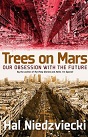
Review: Trees on Mars

Published 14 November 2015 in the Winnipeg Free Press:

Trees on Mars: Our Obsession with the Future
By Hal Niedzviecki
Seven Stories Press, 320 pages, $19

Reviewed by Mike Stimpson

There's a scene in the 1986 film Half Moon Street in which a banker at a dinner party says the world isn't billions of people, but only a few thousand; there are smatterings of individuals in the globe's major cities who matter, he's saying, and all the rest of us don't.

Early chapters of Toronto writer Hal Niedzviecki's thought-provoking fourth non-fiction book (he's also a novelist) bring that scene to mind as he describes how lucrative "challenges" and competitions sponsored by the ultra-rich incentivize tech geniuses to come up with ways to improve civilization with forward leaps in innovation.

That competition approach is supplemented by high schools, colleges and universities with corporate-sponsored programs designed to, in Niedzviecki's words, "prepare students to get to the future first." By which he means anticipating or "knowing" what comes next and developing the right innovations to make the most of the future.

It's an elitist outlook. Like the pompous man in the movie, proponents of this perspective think only a small percentage of humanity (the very wealthy and the very smart) matters and the rest of us are relying on them.

Niedzviecki contends the way we think of the future has changed in two key ways: We now think we can control it, and there seems to be a consensus we must compete with each other to "own" it. This is "a vast systemic shift in our consciousness," he says.

The elite-centred drive to own or "win the future" is all about competition, profit, private greed and individualism. There's not much talk of community or the masses, except as a market for future-conquering innovations.

It wasn't always so, Niedzviecki points out. Getting to the moon was presented as something for all of America in the 1960s. The world's fairs were showcases of technology with the promise of making everybody's life better.

Now the future is a source of anxiety. Youth feel pressure to be among the winners, because life for the losers won't be easy.

Anxiety about "owning the future" comes through when Niedzviecki meets with nine recent university graduates in Toronto. He asks them to jot down a few words on "what you think about when you think about the future," and the group mostly responds with expressions of "their present-day yearning for jobs, stability, a clear path." They don't declare bold dreams of a better world for humanity; they want economic security for themselves and worry they'll not see it for a long while, if ever.

Whether the owning-the-future ideology really is as pervasive and influential as he says is open to debate, but Niedzviecki makes a convincing case it is ultimately toxic.

He also entertains the reader along the way with accounts of visits to academic institutions and tech conferences, not to mention interviews with interesting people such as an Alberta woman who aspires to be among the first Earthlings to live on Mars.

When Trees on Mars is not causing you to worry a little about where society is headed, it is a fun ride. It makes you look forward to what its inquisitive author will produce in the future.

Monday, June 29, 2015

Review: Operation Nemesis

Published 27 June 2015 in the Winnipeg Free Press:
Operation Nemesis: The Assassination Plot that Avenged the Armenian Genocide
By Eric Bogosian
Little, Brown and Company, 376 pages, $31

Reviewed by Mike Stimpson

A sensational murder trial in Germany is at the core of this provocative work of popular history.

On a Berlin street in March 1921, Soghoman Tehlirian killed Mehmet Talat Pasha by shooting the exiled Turkish statesman in the back of the head. There were plenty of witnesses, and Tehlirian freely admitted to the homicide, but a jury acquitted him after a short trial.

The jury sympathized with the 25-year-old defendant, who said he was avenging the 1915 massacre of his parents, siblings and countless other Armenians at the hands of Turkish nationalists led by the man he shot.

What the jury -- indeed, the world -- didn't know at the time was that the slaying of Talat Pasha was part of an international conspiracy to assassinate those behind what would eventually be known as the Armenian genocide of 1915-1916.

Operation Nemesis is the first non-fiction book for Eric Bogosian, an Armenian-American writer and actor best known as the star of the Oliver Stone film Talk Radio (based on a play Bogosian wrote) or as Capt. Ross in a few seasons of Law & Order: Criminal Intent. He set out to write a screenplay about Tehlirian, but instead has produced this moving examination of crimes against humanity and vigilante justice.

The tome has three parts. In Part I, Bogosian traces Turkish-Armenian relations back to early Christianity and explains key events leading up to the "ethnic cleansing" of Christian Armenians by Muslim Turks in the Ottoman Empire when the First World War was young.

The second section is about Tehlirian and the Nemesis conspiracy, named after the Greek goddess of retribution.

Bogosian's skills as a storyteller come out in these middle chapters. Tehlirian is a fleshed-out, three-dimensional character here, an introspective young man so tortured by what might be termed "survivor's guilt" that he is perplexed and disappointed by the cheerfulness of Nemesis teammates in Berlin. His single-minded dedication to the cause makes him a fascinating and sympathetic protagonist.

There's even a love story woven into the narrative. Tehlirian meets a beautiful young Armenian when he's stationed as a soldier in Tbilisi, Georgia, during the war, and reunites with her after the trial. They marry and eventually move to San Francisco, where an Armenian-American millionaire gives the hero a job.

Nemesis operatives assassinated six more former Turkish leaders in Europe in the year or so after the Berlin shooting.

The Tehlirian/Nemesis tale has great movie potential. It's like the story told in Steven Spielberg's Munich, about Israeli operatives getting revenge for slayings committed at the 1972 Summer Olympics.

Unlike the Israelis in Spielberg's film, the Nemesis participants didn't have the resources of a wealthy state (or any state) at their disposal. Also, they were working in a time when international communication was by telegraph.

The book concludes with a few chapters on the emergence of Turkey out of the old Ottoman Empire in the 1920s, Turkey's official denial of the Armenian genocide, and Armenians' continued quest for justice and acknowledgment of the genocide.

The official position of Turkey is that Armenians were not systematically killed and therefore it wasn't genocide. Bogosian contends the Turkish position is hogwash, and has done the research to back up his assessment.

Though he doesn't portray Tehlirian and company as flawless heroes, he clearly sympathizes, saying they "were appealing to a higher, final justice. One that exists somewhere between heaven and earth."

History buffs, especially those who like their history spiced with drama, should appreciate the fine job Bogosian has done in turning an obscure corner of the past into a genuine page-turner.

Saturday, April 4, 2015

Review: The Looting Machine

Published 28 March 2015 in the Winnipeg Free Press:
The Looting Machine: Warlords, Oligarchs, Corporations, Smugglers and the Theft of African Wealth
By Tom Burgis
Public Affairs, 336 pages, $35

Reviewed by Mike Stimpson

For his first book, British journalist Tom Burgis tackles a much-noted paradox: Africa is rich with natural resources, yet the vast majority of Africans live in abject poverty.

Some chalk it up to what's called the "resource curse," but that's more a description than an explanation. Burgis, for years an Africa correspondent for the Financial Times, aims for a deeper understanding and hits his target in The Looting Machine.

The resource curse is, essentially, the idea that countries with lots of mineral wealth tend to have lousy economic development. A wee few in a resource-rich country will become very affluent themselves, while the masses live in crushing destitution.

It's not unique to Africa, but the resource curse seems to apply especially well to the sprawling land mass that's the cradle of our species and home to about 15 per cent of humans but only two per cent of global GDP.

The continent has 40 per cent of the world's gold reserves, 15 per cent of petroleum reserves, 80 per cent of platinum reserves, and much of the planet's diamonds and copper, yet the economic reality for the masses living in African countries flush with those sought-after commodities is rather bleak.

Consider Angola as an example. The former Portuguese colony has an abundance of oil, sizable diamond mines and impressive economic growth that has outpaced China's in some of the 13 years since a protracted civil war ended there. Yet three in four residents of Angola's capital city, Luanda, live in crime-ridden slums without reliable supplies of electricity, and 40 per cent of Angolans live in what the World Bank defines as "extreme poverty."

It's a similar story in oil-endowed Nigeria, where two-thirds live in extreme poverty, and in the Democratic Republic of Congo (formerly Zaire) with its vast wealth of gold, cobalt, copper, diamonds and tantalum. Extreme poverty is reality for about nine out of 10 people in Congo.

In these and other sub-Saharan countries, having great volumes of minerals and gems in the ground has not at all meant economic security for the average citizen.

Explanations vary. Some put the blame on Africa's exploitative colonizers of the past and the International Monetary Fund's neoliberal conditions for "helping" countries in crisis. Others say Africans constantly stymie development with their own "tribal" strivings for greater shares of the wealth.

Cynics and apologists for global capitalism contend that Western journalists and charities are painting a false picture and Africans are, by and large, doing OK.

Burgis, with the benefit of his years of reporting from many locations, gives us his take on the situation. His book details how Africa is being looted by indigenous elites in concert with powerful multinational corporations.

And the big foreign companies aren't just European and North American anymore. China has wedged its way into the racket, largely through the dealings of a shadowy corporation with a mysterious captain named Sam Pa. The 88 Queensway Group, or China International Fund, forged a partnership with Angola's state-owned oil company several years ago, and has since made deals with resource kingpins in other mineral-rich African states.

Through Queensway and its many companies, China has staked its claims on resources to become part of what Burgis describes as a modern colonial-type system that revolves around unholy alliances between "unaccountable African rulers" and rapacious foreign capitalists.

China's doing well by its arrangements with African kleptocracies, as are Western mining and oil companies, but the poor remain very poor.

If you're curious about why the masses in resource-rich Africa are so painfully impoverished, this hard-hitting and eye-opening exposé is worth a look.

Sunday, March 15, 2015

Review: Humans 3.0

Published 14 March 2015 in the Winnipeg Free Press:
Humans 3.0: The Upgrading of the Species
By Peter Nowak
Goose Lane, 248 pages, $20

Reviewed by Mike Stimpson

Where most of us see amusing gadgets, Toronto journalist Peter Nowak sees profound human progress.

His stimulating second book (after 2010's Sex, Bombs, and Burgers) contends that our species is going through a second major technology-driven "upgrade."

In the first upgrade, millennia ago, we transitioned from cave dwellers utterly dominated by nature to tool-wielding Humans 2.0, using crude technology to more easily coexist with nature. Now we're well into the process of using computers, robots and other high technology to "become the main determinants of all of the world's systems, including biology and environment." It's the dawning of an age in which our species pretty much does whatever the heck it wants.

"We're not evolving, we're upgrading, just like software," he declares in the opening chapter. "In the third age of humans, as people master nature rather than coexisting with it or being subjugated by it, we are becoming Humans 3.0."

Some see that as more bad than good, what with global warming and other great environmental problems we hubris-filled hairless apes have caused. Not Nowak -- he's optimistic and thinks it is, on balance, a rather good thing.

Technology is driving economic development everywhere, and thus strengthening international ties and filling people with the hope that comes with prosperity. Increasing numbers of us are using technology to follow our "true entrepreneurial nature," and personal expression and creativity have blossomed.

Internet-related connectivity has enabled the forging of friendships and communities that span the globe as individuals use the web to find others who share their interests and predilections. Human health and lifespans have improved thanks to advances in medical science.

Environmentalists see serious negative consequences arising out of our detachment from nature, but Nowak says we need not be so worried. He acknowledges that human-caused climate change could "wreak havoc on all aspects of life," but reckons our brilliant problem-solving abilities will save us in the end.

Just how we'll tackle that problem, he doesn't say. But, you know, we will. If we can make all these whiz-bang high-tech gadgets and apps to minimize dirty work and instantly update people in far-off places about our lives, then by golly we can avert mass extinction, right? Right?

Likewise, he acknowledges that the recent economic recovery has been short on jobs because businesses are using technology to cut their payrolls. But Nowak reassures the reader that things will balance out in the end, and that we'll be okay. Exactly how, he can't say -- but then he's not an economist.

Nowak sees "a new Golden Age of individualism," and won't let environmental and social-justice concerns harsh his mellow. He maintains a relentlessly sunny outlook on our prospects, which is perhaps unsurprising if you know he's a blogger for Canadian Business. He seems a true believer in the magic of a can-do attitude combined with some entrepreneurial spirit and tech smarts.

You don't have to buy into his aw-shucks wonder and optimism, though, to appreciate Nowak's crisp writing and abundance of interesting facts and insights. Did you know, for instance, that the 250,000 self-published books churned out in the U.S. in 2011 was nearly four times as many as in 2006? Or that futurist Ray Kurzweil projects computer intelligence to surpass human intelligence by 2045?

Humans 3.0 is a good, smart read. You can buy your analog copy today, via the Internet or at an old-fashioned brick-and-mortar store.

Sunday, November 30, 2014

Review: Severed

Published 29 November 2014 in the Winnipeg Free Press:

Severed: A History of Heads Lost and Heads Found
By Frances Larson
Granta, 336 pages, $30

Reviewed by Mike Stimpson

With Islamic State's decapitation of hostages making headlines and leading newscasts the world over, the subject of British anthropologist Frances Larson's new work of popular history is timely.
Larson, an honorary research fellow at the University of Oxford, has written a smart and engaging history of how Western society's fascination with human heads has extended to collecting and displaying them.
Severed is written for a general audience, though some prospective readers may cringe at its subject matter. Those who get past their discomfort are in for a treat.
The brutal execution videos from Syria have understandably repulsed and horrified people here. Yet it wasn't so long ago that Europeans crowded town squares to watch heads get lopped off, and centuries-old heads are on display in churches and museums.
Saint Oliver Plunkett's more-than-300-year-old head, with some hair still clinging to its slowly decaying flesh, is in a glass case at a church in Ireland, just as Saint Catherine of Siena's is kept as a divine relic in Italy.
Perhaps the most famous and talked-about part of Oxford's Pitt Rivers Museum is its collection of shrunken heads from South America.
The place decapitation still holds in popular culture is reflected by enduring figures of speech such as "head on a platter" (a reference to John the Baptist's execution) and "don't lose your head."
Fascination with heads and their separation from bodies is hardly surprising, Larson notes, when you consider that our faces express our personalities and our heads host four of the five senses.
Chopping a head off, then, is a powerful denunciation of what a person has done, and keeping a head on display at a place of worship is an expression of profound reverence.
Sometimes keeping a head or skull can be an expression of deep respect or admiration, such as when a church sexton in Vienna swiped composer Wolfgang Amadeus Mozart's skull.
Other times it has nothing to do with respect and admiration. Larson writes that the shrunken heads at the Pitt Rivers Museum are remnants of "an international trade in exotic collectibles" in the 19th century, when European colonials offered cash and goods for human heads.
In the 20th century, some American soldiers in Vietnam and the Second World War's Pacific theatre kept skulls as trophies. Life magazine sparked outrage in 1944 by publishing a photo of a pretty Arizona woman with a gift her navy boyfriend had sent her: a Japanese soldier's skull.
Indeed, Larson remarks, "The physical detachment of a person's head is often preceded by an assumed social detachment that separates the perpetrator from his victim. This social detachment has often taken the form of racism."
Perceptive and well-written, Severed is a great read even if its subject seems at odds with the holiday season.
It's also, as one might expect of an academic's work, thoroughly researched. The bibliography runs to nearly 30 pages, and Larson promises "detailed notes" at her website.
Larson has a good head. This book is evidence of that.

Friday, September 26, 2014

Review: Technocreep

Published 13 September 2014 in the Winnipeg Free Press:

Technocreep: The Surrender of Privacy and the Capitalization of Intimacy
By Thomas P. Keenan
Greystone Books, 263 pages, $23

Reviewed by Mike Stimpson

By now, surely everyone who has been paying attention knows information technology has compromised our privacy. Surveillance cameras are ubiquitous, business and government track us online, and Facebook has an Everest of user data that it sells to other companies.
So Thomas Keenan isn't exploring much new ground in his book about the "unseen ways" that technology is being used to invade our privacy and try to separate us from our money.
The Calgary-based computer security expert, university professor and journalist has, however, assembled a thorough accounting of ways technology has perniciously crept into our lives.
The title refers to both the "creepy" feeling some uses of technology can give you, and the forward creep or evolution of technology and its uses.
One example of the former is how the FootPath system tracks customers' movements at shopping malls via their cellphones.
Then there's the iPhone app called Girls Around Me, which enables young men on the prowl to identify women in the vicinity who've checked in on Facebook and Foursquare.
An example of the forward creep of technology is... well, evident in everything about every kind of tracking and surveillance technology. It has become more efficient, less expensive and so commonplace that its absence is more remarkable than its presence.
Proprietors of small corner stores can buy security cameras for $50 apiece, and your smartphone sends signals that people can use to keep track of where you go. And that's just for starters.
"Many people believe that these disturbing technologies are confined to the Internet and that if they are careful, or even avoid online activity altogether, they will be safe," Keenan writes in the introduction. "But the technologies that will truly change our lives will be in our cars, our streetlights, our hospitals, and even inside our brains and bodies. Our favourite watering holes, and even our pets and our children, are being infested with technocreepiness."
The creep is so diverse and so unpredictable that lawmakers couldn't keep up even if they wanted to. And the way governments have been spying on their own citizens suggests that legislators are, at best, ambivalent.
Keenan says the public tends to learn about high-tech threats to its privacy in an "episodic" way, as stories of spying and other privacy intrusion appear in the news.
That's true, but his book often feels episodic as well -- chapters are packed with one anecdote after another. Because Keenan isn't skilled at transitions, most chapters feel like information snacking rather than finished entrées.
Technocreep is suitable for mass readership; you don't have to be a technology expert like Keenan, who is good at explaining things to us non-experts.
He does commit one egregious sin in communication, however, when he uses postal abbreviations for states and provinces (VA for Virginia and AB for Alberta, for example).
Postal abbreviations are for envelopes, not books. Keenan should know that, and certainly the book's editor should.
Keenan ends Technocreep with a sort of call to action -- or "a call to conspiracy," as he puts it, saying readers should engage in forums and "stay informed, speak out, and vote on technocreepiness."
Before that, he offers suggestions on what you can do in your own life to find out who's watching you online and then reduce the intrusion. Most of the suggestions are easily followed, though it would take considerable time and effort to follow them all.
We can do things to fight back, he says, but "creepier things are coming our way" and the technocreep is inescapable.
"You have been warned."

Sunday, July 13, 2014

Review: Sons of Wichita

Published 12 July 2014 in the Winnipeg Free Press:

Sons of Wichita: How the Koch Brothers Became America's Most Powerful and Private Dynasty
By Daniel Schulman
Grand Central, 424 pages, $33

Reviewed by Mike Stimpson

Charles and David Koch are famous for two things: enormous wealth derived from Koch Industries, and support for right-wing causes. Sons of Wichita covers both those themes, as well as the duo's decades-long conflict with their brothers.
Daniel Schulman, Washington senior editor for Mother Jones magazine, clearly did a thorough job researching along all three themes. And he seems to have taken pains to treat the controversial billionaires fairly -- perhaps a bit too fairly (but more on that later).
Koch Industries has its roots in oil refining, specifically a refining process Fred Koch and partners developed in the late 1920s. Since Fred's death in 1967, two of his four sons -- he had no daughters -- have expanded the company through acquisitions that include the makers of, among other things, Brawny paper towels and Lycra fabric.
Their empire also includes a notable Manitoba component: the Koch Fertilizer plant in Brandon.
For decades, Charles and David emphasized the "private" in the privately held company they control.
Sure, Charles used his wealth to fund the libertarian Cato Institute think-tank, and David was on the Libertarian presidential ticket in 1980. Otherwise, however, they kept a low profile and avoided the spotlight.
That changed after Barack Obama's election to the White House in 2008.
"Charles considered him a 'dedicated egalitarian' who had 'internalized some Marxist models,'" Schulman writes. "David... declared him 'the most radical president we've ever had as a nation,' a leader steeped in the 'hard core economic socialist' politics of his Kenyan father."
The billionaires decided they had to act quickly in response to the Obama threat. They did so by seeing that Americans for Prosperity, an organization that gets much of its funding from the Kochs, supported the "tea party" rallies that sprang up across the U.S. in 2009.
Their role in anti-Obama activities became well-known and the brothers became, in Schulman's words, "the Punch to Obama's Judy in the partisan puppet show."
The business and political aspects of the Koch story are interesting, but Sons of Wichita actually begins with a vivid scene from the 1950s on the theme of sibling rivalry: teenage David and twin brother Bill, both wearing boxing gloves, angrily throwing punches at each other near the family estate in Kansas.
That scene foreshadowed a 20-year conflict Bill was to have with David and Charles through the 1980s and '90s. With oldest brother Frederick on Bill's side but minimally involved, the war was waged in the boardroom, until Bill was kicked out of Koch Industries, and then continued through a series of lawsuits Bill filed against David and Charles.
They reached a settlement in 2001, and haven't publicly sniped at each other since.
Bill has an energy company of his own, Oxbow Corp., and spent many millions of dollars to win the America's Cup yachting trophy in 1992.
Frederick, who will turn 81 in August, has since the 1960s led a guardedly private life, with no involvement in Koch Industries. He's known in New York and Europe as a generous patron of the arts.
Schulman and his aides have clearly done their research, as evidenced by 30 pages of endnotes, and Sons is very well-written.
But it's a tad disappointing that someone from a liberal-left "hell-raiser" magazine such as Mother Jones would pull his punches so much on the right-wing "Kochtopus."
Schulman goes out of his way to be fair to these fomenters of anti-Obama rage, whether they deserve it or not. A little invective would have been appreciated.
Charles and David might disagree with that, but surely as libertarians they would defend a reviewer's right to say it.

Sunday, February 23, 2014

Review: Young Money

Published 22 February 2014 in the Winnipeg Free Press:
 
Young Money: Inside the Hidden World of Wall Street’s Post-Crash Recruits
By Kevin Roose
Grand Central Publishing, 320 pages, $30

Reviewed by Mike Stimpson

The Wall Street analysts at the heart of Young Money don't party as hard as The Wolf of Wall Street's Jordan Belfort, but then they're working with much smaller disposable incomes.

After all, the highest-paid among the eight recent college grads shadowed by journalist Kevin Roose pulls in maybe $150,000 in a year -- big bucks by most people's standards but a small fraction of what Belfort scammed in his days of living high.

This is the second book by Roose, a business writer for New York magazine.

He followed the young financiers for three years, beginning at their recruitment by investment banks in 2010 -- less than two years after the great crash of September 2008 -- and found them to be appreciative of their remuneration but generally unhappy with their work lives.

Young Money is entertaining, helped in good part by the author's remarkable adeptness at weaving several narrative threads without confusing the reader.

Wall Street banks expect their new recruits to work 100-hour weeks and be available at any time; as a result, first- and second-year analysts tend to be highly stressed and lack robust social lives outside the office.

By the third year of Roose's project, some of his eight subjects have left the banks, a couple have left the finance sector altogether, and all seem at least a little weary and disillusioned. Pay aside, the Wall Street life is a hard life for rookies.

Short, breezy chapters introduce us to and then follow the odysseys of the recruits. All start their jobs with an eagerness that quickly dissipates as demands wear them down.

Chelsea, for instance, begins her time at Merrill Lynch as a diligent member of the firm's public finance team, but quickly grows frustrated with working long hours under a high-strung control freak who doesn't have her back when she makes a mistake.

Jeremy works at Goldman Sachs, where his days are made miserable by a boss with an explosive temper; after his first year, he notices that his own temper has shortened and he's often unkind.

Chelsea and Jeremy both leave their employers. When Jeremy quits, he writes on Facebook that "the nightmare is over."

Roose admits that his pool of "conflicted" sources may well be an unrepresentative sample.

"My banker sources were atypical by definition -- daring or disillusioned enough to be willing to risk getting fired by talking to me, and kind and introspective enough to spend hours at a time answering probing questions about their lives," he writes.

The tracking period of the recruits runs through the Occupy Wall Street days of 2011-2012. Roose's subjects give little thought to the Occupy movement, though none of them are entirely dismissive towards the protesters' issues.

A couple of them do wonder aloud, however, if their work is doing much good at all for society.

Roose finds it sad that so many bright people from prestigious universities get drawn in by Wall Street's money appeal every year.

He worries that Wall Street will change some of the "socially conscious" young people he met, and change them for the worse.

He wants to see the allure of Wall Street fade so that more "highly creative young people use their abilities for purposes other than padding an investment bank's bottom line."

There's nothing deep or groundbreaking about Young Money, unless you're surprised to learn that Wall Street is a high-stress work environment.

Nevertheless, it's a thoroughly readable look at what it's like to toil as a junior analyst for a big investment bank. It gets a "buy" rating.

Saturday, October 5, 2013

Review: The Witness Wore Red

Published 5 October 2013 in the Winnipeg Free Press:

The Witness Wore Red: The 19th Wife Who Brought Polygamous Cult Leaders to Justice
By Rebecca Musser with M. Bridget Cook
Grand Central Publishing, 340 pages, $29

Reviewed by Mike Stimpson

No fiction writer, not even one as darkly imaginative as Stephen King, could create a villain creepier than Warren Jeffs.

The 57-year-old convicted rapist is the feature miscreant in Rebecca Musser's engrossing memoir of life in a closed society of polygamist Mormons.

Fundamentalist Church of Jesus Christ and Latter-Day Saints (FLDS) members, living mainly on a patch of desert straddling the Utah-Arizona border, observe every pronouncement he sends to them from inside a Texas penitentiary where he is serving a life sentence.

FLDS members cling to the doctrine of "plural" or "celestial" marriage, a principle discarded by the mainstream Mormon church in 1890. They believe a righteous man can secure a place in the highest level of heaven by taking three or more wives.

In clear, crisp prose, Musser and co-author Bridget Cook take us on a journey from growing up in a household with more than 20 other children and more than one mom, to being a teenage bride for an 85-year-old man, to escape and a life of advocacy for the oppressed and enslaved.

This insider's account includes truly shocking details on how the sect robs girls of their freedom and dignity.

Perhaps the most disturbing content is a partial transcript of an audio recording of Jeffs having sex with a 12-year-old wife while other wives watched. In comparison, the renegade sect leader Roman Grant in the HBO series Big Love was a choir boy.

But Musser and Cook aim for inspiration rather than sensationalism, with themes of faith and empowerment.

Musser was born Rebecca Wall, the fifth of 14 children from her father's second wife. Her father eventually had three wives and 24 children.

Shortly after her 19th birthday in 1995, Musser became the 19th wife of Rulon Jeffs, who was president of the FLDS and Warren's father.

They lived in the Jeffs family's sprawling compound in Hildale, Utah, and Rulon added many more young wives before his death at age 92 in September 2002.

Warren repeatedly admonished Musser that it was her religious duty to obey and please the old church leader in every way, including sexually.

Two months after Rulon's death, Warren as the new FLDS president told Musser she must remarry.

He said her new husband could be him, and the possibility wasn't far-fetched since he had already married some of his father's other young widows.

In response, she quickly planned and executed an escape from Hildale.

She and a young FLDS man named Ben Musser fled to Oregon and married.

They're now divorced but both live in Idaho, where they are parents to a son and daughter.

She has testified against Jeffs and other FLDS men to help bring them to justice for their crimes against girls as young as 12.

She wore red each time she testified against Jeffs because he had banned FLDS members from wearing the colour.

As founder of a non-profit foundation called Claim Red, she is now a voice for victims of human trafficking.

A younger sister, Elissa Wall, co-authored the 2008 book Stolen Innocence about her own experiences in and escape from the FLDS.

Atheists hoping The Witness Wore Red slams faith will be disappointed. Musser rejects leadership by one man, but not religion and spirituality.

It's also notable that the word "cult" appears in the subtitle but nowhere in the memoir itself, as Musser remains respectful and sympathetic toward the community she left -- even though much of that community despises her as a traitor.

Sunday, June 2, 2013

Review: Denial

Published 1 June 2013 in the Winnipeg Free Press:

Denial: Self-Deception, False Beliefs, and the Origins of the Human Mind
By Ajit Varki and Danny Brower
Twelve, 384 pages, $30

Reviewed by Mike Stimpson

This thought-provoking work of popular science contends that the human brain must have found a way to push thoughts of death aside before the species could develop into fully aware, intellectually robust beings.
That's debatable, but the authors certainly present an intriguing theory, and in mostly jargon-free prose that non-scientists can follow.
Denial's provenance, as explained in the book's introduction, is interesting on its own.
Ajit Varki, a physician and professor at the University of California, San Diego, met University of Arizona geneticist Danny Brower at a biology conference in 2005.
They had a private conversation in which Brower explained his theory about a critical point in the evolution of our species.
Varki found his own thoughts returning to the idea over the ensuing two years, and eventually decided to call Brower for further discussion.
Brower had, however, died of a rare blood vessel disease, his theory not developed into a full-length book.
Now India native Varki has finished the job, having polished and added to a manuscript Brower left behind.
The pair contend that, at some juncture early in our evolutionary saga, our ancestors had to have developed the neurological wiring for reality denial. They say it was absolutely essential.
Here's why.
An animal with full awareness of itself and the world around it would understand that its own death is inevitable.
The fully aware animal, say the authors, would be unable to cope and survive with the acknowledgement of mortality.
The mortality-conscious individual's behaviour would be too weird for others in its species, and it would therefore not mate -- an "evolutionary dead end," since it would produce no offspring.
To avoid this dead end, Varki and Brower contend, Homo sapiens needed to have evolved the ability to deny or repress unpleasant bits of reality. In particular, to deny the reality of mortality.
The pair defines denial as a "defence mechanism used to reduce anxiety by denying thoughts, feelings or facts that are consciously intolerable."
They say the capacity for reality denial allowed us to "become really, really smart" compared to other animals, while any individual of another species who developed full awareness would been doomed to hit the brick wall at the end of the evolutionary dead end.
Varki and Brower present (to quote Charles Darwin) "one long argument" for their speculative theory, but admit they can't "prove" it.
Even assuming that it's such a bad thing to realize one is going to die, couldn't there be other ways to avoid the dead end?
Isn't it possible, for example, that the drive to pursue pleasure and avoid pain is just so much stronger than worries about death? Or that social or community priorities, such as the support and defence of one's family or group, override mortality concerns?
But you don't have to buy into the central thesis to appreciate Denial. There's plenty more to keep the reader engaged.

Saturday, March 2, 2013

Review: Beyond Belief

Published 2 March 2013 in the Winnipeg Free Press:

Beyond Belief: My Secret Life Inside Scientology and My Harrowing Escape
By Jenna Miscavige Hill with Lisa Pulitzer
William Morrow, 404 pages, $19

Reviewed by Mike Stimpson

To most of us, Scientology is the peculiar religion that counts movie star Tom Cruise among its adherents.

Jenna Hill knows it as the church that robbed her of her childhood and tore her family asunder.

The apostate Scientologist tells her fascinating story of survival in Beyond Belief, a long memoir that captivates the reader from cover to cover.

Hill is the San Diego-based niece of Scientology leader David Miscavige. Her parents were also high-ranking executives in the church for 15 years until leaving it in 2000.

When she was just seven years old in 1991 she signed a billion-year contract to serve the church in its elite Sea Org.

Yes, that's right: a billion years. Sea Org members are expected to serve for as long as they can in their current lives, and resume service in subsequent ones.

Hill says she "felt no hesitation" in signing the contract. Her age was practically irrelevant, she explains, because Scientology holds that every person is an ancient soul (or "thetan") "capable of the same responsibilities" at any age.

That reasoning justified putting children through physical labour at the Sea Org Cadets camp where she lived during what should have been her school years.

The daily routine at the California camp, called "the Ranch," included an early morning wake-up call, a military-style "muster" or assembly, a few hours of labour (carrying old railway ties, for example), some secular schooling in the afternoon without teachers, and Scientology indoctrination in the evening.

From wake-up call to the end of evening sessions, it was a 14-hour day with no time for the sort of play or recreation a normal child would enjoy.

Her parents, Ron and Elizabeth Miscavige, lived several kilometres away and saw her for only a few hours every weekend.

Hill left the Ranch in her middle teens to work and study Scientology at the church's "Flag Land Base" in Florida, where she was routinely interrogated, bullied and reprimanded.

Any deviation from church policy or doctrine was committed at risk of being reported to the bosses and subjected to a "security check," essentially a session of badgering that would end only when she admitted to some sin (or "overt" in church terms) against Scientology.

Needless to say, she learned to keep her thoughts to herself and be careful in the presence of other Sea Org members.

The church flew her back to California when her parents exited, and gave her the option of leaving to live with them.

She refused, largely because she felt too committed to Scientology -- "brainwashed," she admits now -- to leave it.

Another factor in her decision was that she was 16 at the time, and leaving the church would have also meant enrolling in school. She knew her education wasn't up to snuff.

Hill finally reached her breaking point when the church tried to prevent her marriage to Dallas, a fellow Sea Org member, and then tried to keep them apart after they married.

She tried to "route out" of the Sea Org on good terms with the church, but those efforts were met with hostility and harassment.

It was only after leaving Scientology that she learned of some of its wackier beliefs, such as the story of a galactic overlord dumping aliens into Earth volcanoes millions of years ago.

She co-founded a website for ex-Scientologists in 2008.

Beyond Belief comes soon after Pulitzer Prize winner Lawrence Wright's Going Clear: Scientology, Hollywood and the Prison of Belief was published to much fanfare south of the border. Due to Canada's more plaintiff-friendly libel laws, Going Clear isn't available in Canadian bookstores.

Hill's book is not only a good substitute, it's a terrific tome in its own right. Interesting, informative and accessible, this insider's story is well worth the price.

Saturday, December 1, 2012

Narrow perspective harms war correspondent's memoir

Published 1 December 2012 in the Winnipeg Free Press:

Is This Your First War? Travels Through the Post-9/11 Islamic World
By Michael Petrou
Dundurn, 220 pages, $25

Reviewed by Mike Stimpson

The prologue for Canadian journalist Michael Petrou's war-zones memoir seems to signal that the book will be a screed against the scourge of militant Islam.

He writes of the "spectre of Islamist extremism," words that remind the reader of how Marx and Engels wrote of 19th-century Europe being spooked by "the spectre of communism."

He certainly lays his biases on the table as he decries the terrible Islamists who are "like radical Marxists" and says their hateful ideology is "like fascism and communism."

Also in the prologue, he mentions western soldiers, politicians, diplomats and "people outside embassies" that he spoke to, but no learned critical observers, as his chief sources.

One could be excused for expecting, after reading the prologue, a badly biased book based entirely on the sorts of conventional sources that lazy journalists use to lard their daily output. And one wouldn't be entirely wrong.

First War is biased, though not too badly, and it is poorer for the author's refusal to consider viewpoints much outside his narrow perspective. But it turns out to be not as tedious and shallow as its prologue suggests.

It is, to be blunt, not especially thoughtful or well written. Nor does it offer much, aside from the Maclean's reporter's particular war stories, that hasn't been presented elsewhere. But it is entertaining in spots.

There are plenty of tales from Petrou's visits to Afghanistan, Iran, Sudan and Israel, plus an unsuccessful attempt at getting into Iraq via Turkey.

The reader meets some interesting people in these stories, such as the Afghan man who once was thrown in jail by the Taliban for teaching schoolchildren the words Christianity, Judaism and Hinduism -- not the religions, just the words.

Then there are the Iranian dissidents who risk incarceration and torture by meeting with Petrou in Tehran.

One destination outside the Middle East is New York City, where he predictably describes the burg's firefighters as "brave" and "selfless."

He writes of America's "terrorist problem," and it surely has one, but nowhere in First War does he admit that the U.S. might in any way have done things to inspire terrorism against it.

When in Israel, Petrou is told by a militant Jewish West Bank settler that Palestinians didn't live in the area until the state of Israel was created. The assertion is left uncorrected until 14 pages later.

Petrou signals his biases when he challenges a Palestinian Muslim leader much more strongly than he challenges any of his Israeli sources.

This book does not question the wisdom or ethics of the western occupation of Afghanistan, nor does it offer any serious appraisal of the Iraq incursion.

Petrou says he was in favour of the latter to liberate Iraqis from a terrible dictator, and doesn't seem to have given more than the slightest consideration for the legal and ethical case against it.

Noam Chomsky and Gwynne Dyer would not have been around for face-to-face interviews while Petrou was in war zones, of course, but he could have read some of their work to re-examine his biases.

He seems like a bright guy -- he went to Oxford for graduate studies -- so he likely has read at least a little Chomsky. Still, there's no sign in this book that he gave it much thought or even understood it.

War correspondents go into places where many of us would refuse to tread, and for that they deserve our admiration.

But that doesn't mean they can write excellent books. In this case, the war correspondent didn't.

Saturday, August 25, 2012

'Everything is ugly ... wish you were here'

Published 25 August 2012 in the Winnipeg Free Press:

Visit Sunny Chernobyl
And Other Adventures in the World’s Most Polluted Places
By Andrew Blackwell
Rodale, 306 pages, $30

Reviewed by Mike Stimpson

The best parts of this engaging travel memoir relate not to places but to people who live in some of the globe's most befouled locales.

A bright, friendly Alberta oil sands worker welcomes the author, an American journalist, into his home and asks: "So, are we raping the planet?"

A Texas oil refinery employee casually admits he knows he's "gonna get some kind of cancer," and says his co-workers share that expectation about themselves.

"Coin collectors" (who collect much more than coins) wade in India's filthy Yamuna River, philosophical about what they must endure to earn a living.

In Ukraine, the tour guides who take people to the site of a great nuclear meltdown seem unbothered by the high radiation levels and attend a disco at night.

Visit Sunny Chernobyl is the first book by Andrew Blackwell, a journalist, filmmaker and self-described "eco-friendly liberal" who lives in New York.

His aim isn't just to entertain us with stories about places far more polluted than our patch of the Canadian Prairies, though he does that very well.

No, he's also testifying to the adaptability of people and nature -- how they will make the most of even very bad situations.

Moreover, he's saying we should learn to appreciate even the parts of our world that are, to conventional thinking, the ugliest. It's a sadly narrow esthetic that loves only the prettiest.

Indeed, Blackwell contends in the concluding pages that "to chase after the beautiful and the pristine (is) to abandon most of the world."

Besides, he sees good things in each of the polluted destinations.

"I love the ruined places for all the ways they aren't ruined," he writes. "Does somebody live there? Does somebody work there? Does somebody miss it when they leave?"

He got the idea for this book a few years ago, when he happened upon Kanpur, India.

Kanpur is a big city, with a population in the millions, but it isn't mentioned in travel guidebooks. That's probably because it's been called India's most polluted city.

Blackwell could see how the old industrial city earned its reputation as grossly polluted, but he also saw that civilization and nature had worked out an entente in Kanpur.

He wanted to see how people lived in other highly polluted places, so he worked out a plan to see some of them as a pioneer in "pollution tourism."

He admits the silliness in declaring a few places the "most polluted" and declaring one more polluted than another.

Comparing Chernobyl's radiation to a Chinese city's heavy smog is, he says, "comparing cesium apples to carbon oranges."

Blackwell says many environmentalists have unrealistic goals of creating and preserving pristine conditions.

Like it or not, he says, that ship has sailed and we need to proceed with a clear-headed understanding of what can be done with what we now have.

He doesn't elaborate much on that philosophy, perhaps leaving it for another book (or deeper thinkers).

He does argue for an esthetic viewpoint that embraces both the "pure" and the "ruined" for what they have to offer.

Simplistic ideas about "what counts as beautiful" are "a force for disengagement," he writes.

In other words, people do their darndest not to give the "ugly" polluted places any thought. As a result, they don't care about those places.

And that's a woeful mistake, according to Blackwell.

Thoughtful and informative, Visit Sunny Chernobyl will entertain you and might change the way you think about the environment.

Saturday, April 14, 2012

Web watchers gather more and more information about us

Published 14 April 2012 in the Winnipeg Free Press:

The Virtual Self: How Our Digital Lives Are Altering the World Around Us
By Nora Young
McClelland and Stewart, 240 pages, $30

Reviewed by Mike Stimpson

You are being watched.
Complete strangers are gathering information on your movements, your interests, and what you buy.
That fundamental reality of the digital age is the focus of CBC Radio broadcaster Nora Young's first book.
The former Winnipeg resident, currently host of weekly digital-culture program Spark out of Toronto, has written a thoughtful and engaging examination of how we leave trails of data about ourselves every day.
Whenever you use your cellphone, especially if it's a "smart" phone such as a BlackBerry, you're revealing a little about yourself. Same with when you surf the web on your Mac or PC.
And there'll be a creeping advance in digital tracking as what's been called "the Internet of things" continues to grow.
The Internet of things is the connection of non-computer items such as refrigerators and bus stops to the Internet to record and transmit data.
That can be a good thing, recording data that can be used to better manage parts of our daily lives and public services, but it also means a little more opportunity for unseen parties to track what we're doing and where we're going.
Much of your "digital trail" is left "passively" -- that is to say, without you thinking about it and giving permission.
Your laptop might pick up a "cookie," for instance, when you visit a website.
Other times, you are actively and knowingly surrendering information to the cyberworld.
When you post a "status update" or click a "like" button on Facebook, for example, that's data someone might throw into a pile for market research.
There's usually nothing personal about it; your data is but a drop in a vast sea of ones and zeros.
Nevertheless, the watching is real and it raises serious concerns about privacy and information control.
For much of The Virtual Self, Young explores the phenomenon some have dubbed "personal metrics" but she prefers to call "self-tracking."
It's the practice of keeping a record of one's daily activities in particular respects, such as how far you walk or what you eat.
There's nothing new in keeping a daily log, as history is full of famous diarists and compulsive record-keepers. Benjamin Franklin, for example, tracked his own daily behaviour in an attempt to become more virtuous.
What's new is how people send data on their daily lives out into that amorphous data pool we call the Internet.
Young observes that modern self-tracking offers benefits to users, in both individual self-improvement and building a sense of community with people near and far.
She notes the Internet can connect us with people who share our interests, and we can learn about things that matter to us through their postings on Facebook and other sites.
Furthermore, she says, "we can learn about people we can't be physically near," and we can get a feel for what like-minded people are thinking about.
Though it's only, as she says, a "lightweight sense of connection," that aspect of self-tracking and online sharing is still unquestionably a good thing.
But remember: When you upload that data about your daily walking distances or television viewing or whatever, it becomes accessible to a whole lot of people.
Who uses that data and for what purposes are important issues, and Young closes with a chapter on how "data activists" can unite to see that it's employed for good more than bad.
"In this new information ecosystem, more can -- and will -- be known about us than ever before," she writes. "We can choose to do nothing about it, or we can claim that data as our own and actively engage with how it's used."
She believes that we can, together, see to it that our data gets used for our benefit as a society.
"We need to ask questions now about how that information ought to be used" and demand rules to ensure proper use, she declares.
Young seems optimistic that data activists can set things right. Perhaps a little too optimistic.
Wouldn't her data activists, after all, often be going up against very rich and powerful interests that tend to get their way?
And isn't it rather difficult to enforce rules in the modern-day Wild West that is the Internet?
The author's unfounded optimism aside, this book offers a lot of interesting ideas and intriguing questions.
Buy it with cash and you might not leave a digital trail.

Saturday, December 10, 2011

Fools rule politics of climate change

Published 10 December 2011 in the Winnipeg Free Press:
Fools Rule: Inside the Failed Politics of Climate Change
By William Marsden
Knopf Canada, 325 pages, $30

Reviewed by Mike Stimpson

One conclusion to be drawn from Montreal journalist William Marsden's new book is that this year's federal election was another setback in the fight against global warming.

The May 2 vote's outcome was a majority in Parliament for a Conservative party that is rife with "climate change deniers" and beholden to oil companies.

Fools Rule is a well-researched, highly readable followup to Marsden's 2007 book about Alberta's oil sector, Stupid to the Last Drop.

He makes clear in Fools Rule's first chapters that the change from Liberal to Conservative government in 2006 altered Canada's role in climate talks for the worse.

As Canada's Liberal environment minister in 2005, Stephane Dion went the extra mile to get a diplomatic breakthrough in Montreal that brought the United States back to negotiations.

The present government, by contrast, has allied itself with countries that stonewall on proposals for curbing emissions of the "greenhouse gases" that are driving temperatures upward.

Now that the Conservatives have a majority, we can expect a still more negative approach.

This book gives plenty of colour on climate change diplomacy and how it has gone off the rails and been almost completely unproductive with each international summit.

Marsden describes climate-change talks as a "clumsy tango" of dance partners working at odds with each other.

Many countries have been sincerely striving for global reductions in greenhouse gas emissions, but powerful countries have thwarted those efforts.

Canada was among the countries trying to keep the 2009 Copenhagen summit from reaching an effective pact.

Those countries largely succeeded, and the next year's conference in Cancun, Mexico, was a shambles as well.

Canada's economic interests as a petroleum exporter have led it away from doing the right thing, says Marsden, and it's hard to disagree with that assessment.

One need only consider Ottawa's recent stumping for the Keystone XL pipeline to see how oil money trumps environment in Prime Minister Stephen Harper's cabinet.

Marsden makes an interesting point about how "social trap" theory applies here.

He sees the failure of climate-change talks as an expression of how people often will "pursue short-term gain" even when they know their actions will hurt everyone in the long term.

In Canada's case, the pursuit of oil profits is overcoming the long-term interest of ensuring a livable planet for future generations.

Another interesting observation is that those who are most ignorant about the science of climate change are among the most cocksure about being right. As Marsden pithily puts it, "stupidity breeds unbridled confidence."

He despairs that traditional diplomatic processes simply will not resolve this issue, and suggests the answer may lie in getting scientists, economists and other non-diplomats and non-politicians to produce a plan of action.

That seems unlikely, however. Which leaves the reader feeling a bit gloomier about the future.